Research problem研究问题
Fine-tuning and model variants can satisfy different stakeholders, but maintaining many specialized copies is resource-heavy and difficult to scale.微调与模型变体可以满足不同利益相关者,但维护大量专用副本会消耗资源,也难以扩展。
2025 · WWW RESEARCH
AI Model Modulation with Logits Redistribution基于 Logits 重分布的 AI 模型调制
A retraining-free way to make one pretrained model express different utility levels or focus on different input features—without maintaining a separate model for every requirement.无需为每种需求维护独立模型,也无需重新训练;通过调节 Logits,让同一预训练模型呈现不同效用水平或关注不同输入特征。
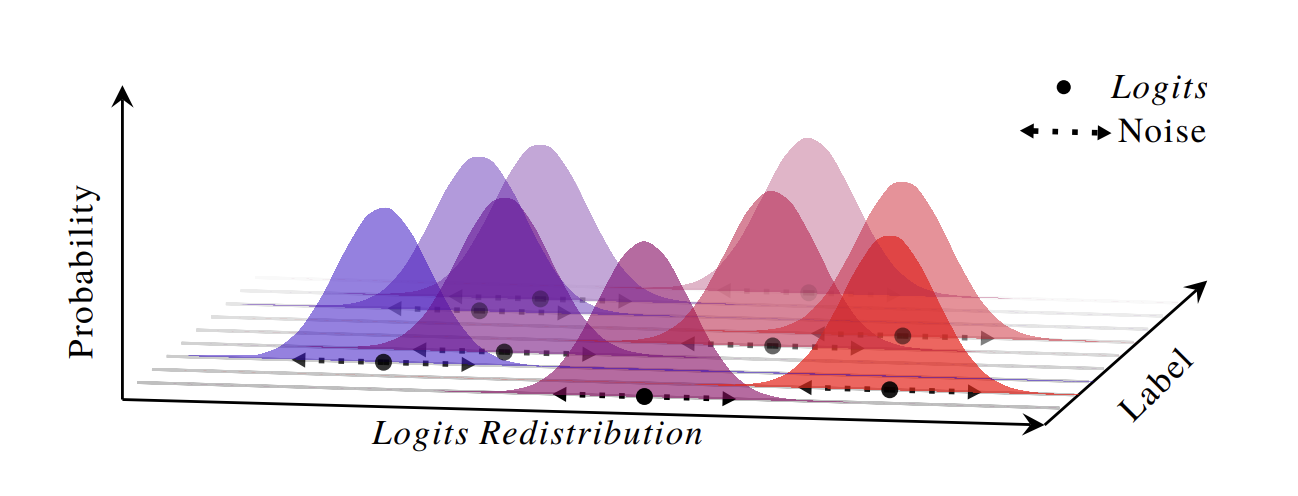
Fine-tuning and model variants can satisfy different stakeholders, but maintaining many specialized copies is resource-heavy and difficult to scale.微调与模型变体可以满足不同利益相关者,但维护大量专用副本会消耗资源,也难以扩展。
AIM changes the ordering and distribution of logits at the model’s final decision layer while leaving learned representations and weights intact.AIM 在模型最终决策层改变 Logits 的排序与分布,同时保持已学习的表征与权重不变。
The method supports utility and focus modulation across image classification, semantic segmentation, and text generation.该方法在图像分类、语义分割与文本生成任务上实现效用调制和焦点调制。
Modulation design调制设计
Logits are where learned features become ranked output choices. AIM redistributes them with controlled statistical functions, avoiding new training data and weight updates.Logits 是学习特征转化为排序输出的位置。AIM 通过可控统计函数重分布 Logits,不需要新增训练数据或更新权重。
Bilateral noise changes overall utility in measured increments, giving model owners one deployment with adjustable service levels.双侧噪声按可测量幅度改变整体效用,让模型所有者在同一部署中调节服务水平。
One-sided adjustments increase or decrease the model’s responsiveness to selected labels or input features.单侧调整增强或减弱模型对指定标签或输入特征的响应倾向。
Joint probability distributions over logits ordering provide the formal basis for predictable modulation behavior.基于 Logits 排序的联合概率分布,为可预测的调制行为提供形式化基础。
The same paradigm is evaluated across vision, segmentation, and language-generation stacks.同一范式在视觉、分割与语言生成技术栈中完成评测。
Evaluation surface评测范围
The implementation covers CIFAR image classification with ResNet, ADE20K-style semantic segmentation with SegFormer, and language-model evaluation through a modified OpenCompass stack for Llama and Qwen-family models.实现覆盖基于 ResNet 的 CIFAR 图像分类、基于 SegFormer 的 ADE20K 类语义分割,并通过改造后的 OpenCompass 对 Llama 与 Qwen 系列模型进行语言任务评测。